Trade a six-figure account that isn't your money — and keep 99% of the profit
Prop trading lets you trade a funded account far larger than most people could risk on their own, while your downside is capped at the cost of the account. This guide walks through exactly how I got started with Upcomers — including the mistakes that cost me 14 accounts before I passed a single challenge.
Heads up: the link above is a referral link and I earn a commission if you sign up — at no extra cost to you. Full disclosure just below.
Full disclosure — please read this first
When you sign up to Upcomers through the link or code yfqv1119 on this page, I earn a referral commission. It costs you nothing extra — in fact the link gives you a better price than going direct.
There's a second part worth knowing, and I think it's the more important one: I also receive a share of the 1% that Upcomers keeps from funded-account profits. In plain terms — I earn a bit when you sign up, but I keep earning only if you actually trade well and reach payouts. My incentive is tied to your long-term success, not just your click. That's also why I've put real work into the bot and guidance further down: if you do well, we both do.
I'm telling you all of this up front because I'd rather you trust the rest of this guide than discover it later. It still doesn't make prop trading right for you — decide that for yourself.
Important note: where I share my own preferences, settings, or strategy in this guide, they are exactly that — personal examples. Nothing here is a recommendation or financial advice.
By the end of this guide you'll have
1A clear path from first sign-up to trading a funded account.
2A solid discount on your account. The link applies Upcomers' current best public promotion, and the code yfqv1119 adds an extra 5% on top of it.
3My trade-entry bot and the exact risk rules that ended 14 blown accounts.
Before you decide — the honest risk picture
Prop trading is high-risk. A few things worth being clear-eyed about before you spend a cent:
The evaluation fee is a real cost you can lose. If you don't pass the challenge, that money is gone. Most people who attempt a prop challenge don't pass it. The good news is that the usual reason is risk management, not strategy — and risk management is learnable. That's what most of this guide is about.
Only use money you can comfortably afford to lose, and check that prop trading and the products involved are legal and available where you live before signing up. If any of that doesn't sit right, it's completely fine to close this tab.
The basics
What is prop trading?
Prop trading (proprietary trading) means a firm gives you a funded account to trade with. You take the trades; you and the firm split the profits. You get access to far more capital than most people could put at risk on their own — and your downside is limited to the cost of the account.
This guide focuses on getting started with Upcomers, which is the firm I personally use. In my experience it has paid out reliably and on time — which is the main reason I keep trading with it. Your experience may differ, so do your own checking too.
Why I trade with Upcomers
199% profit share. You keep $99 of every $100 you make on a funded account — Upcomers takes 1%. Many other prop firms take 10–20%.
2High-quality platforms. MetaTrader 5, Match-Trader, and my personal favourite, TradeLocker.
3Your fee back, plus a bonus. When you receive your first payout, Upcomers refunds your registration fee and adds a free bonus account. So if you reach that first payout, your entry effectively costs nothing — but that's conditional on succeeding, which not everyone does.
4Real support. Live help on Discord and by email — in my experience, fast answers from real people.
These are my reasons and my experience. Terms change, so confirm the current details on Upcomers' own site before you sign up.
Why you should take risk management seriously
My story: 14 blown accounts before I passed
I want to be straight with you, because the glossy version of this helps nobody. Before I cleared a single challenge, I blew 14 accounts.
Not because I couldn't read a chart. Almost every one of those accounts died the same way: a trade went against me, I told myself it would come back, I moved my stop — or removed it — and one bad position quietly grew until it tripped a loss limit. Strategy was never the problem. Discipline was. I kept paying the entry fee, kept making the same mistake, and kept calling it bad luck.
What finally changed things wasn't a better setup. It was a hard rule I stopped negotiating with: a fixed maximum loss per trade, a fixed maximum loss per day, and a promise to walk away the moment I hit it. The account that passed wasn't my best trading — it was my most boring. That's the whole point. The bot and guidance I share lower down exist to make that boring discipline automatic, so it doesn't depend on how you feel at 3pm on a red day.
If you only take one thing from this page, take this: the traders who get funded aren't the ones with the flashiest strategy. They're the ones who respect the loss limits.
Once it clicked
The flip side is real too. Once the discipline was in place, the green days followed. Here's what that boring, disciplined trading actually looks like in the numbers:
Past results — mine or anyone's — don't predict your results. Screenshots show what happened, not what will happen.
Not ready to buy yet? Save this link — I'll email it so you can come back when you are.
Rules and requirements
Understanding the challenge
Every prop account comes with rules, and Upcomers is no exception. Those rules protect the firm from losses — but they also do something for you: they build the discipline that separates traders who get funded from traders who don't.
The most important term to know is the Challenge. Most account types start with one or more challenge phases. A challenge is how you prove to the firm that you can trade before you reach the funded phase. To pass, you follow the rules and hit a profit target — typically 3%–8% of your account size.
You don't earn money during the challenge phase — but with Upcomers there's no time limit on the classic evaluation, so you can take the time you need to do it right.
One reality worth knowing up front: most people who attempt a prop challenge fail it, and the reason is almost never strategy — it's risk management. That is exactly what the rest of this guide, and my entry bot, are built to help you get right.
Upcomers profit and payout structure
Account rules differ between packages. Let's walk through a classic package using a single example — a 100K account — so the numbers are easy to follow.
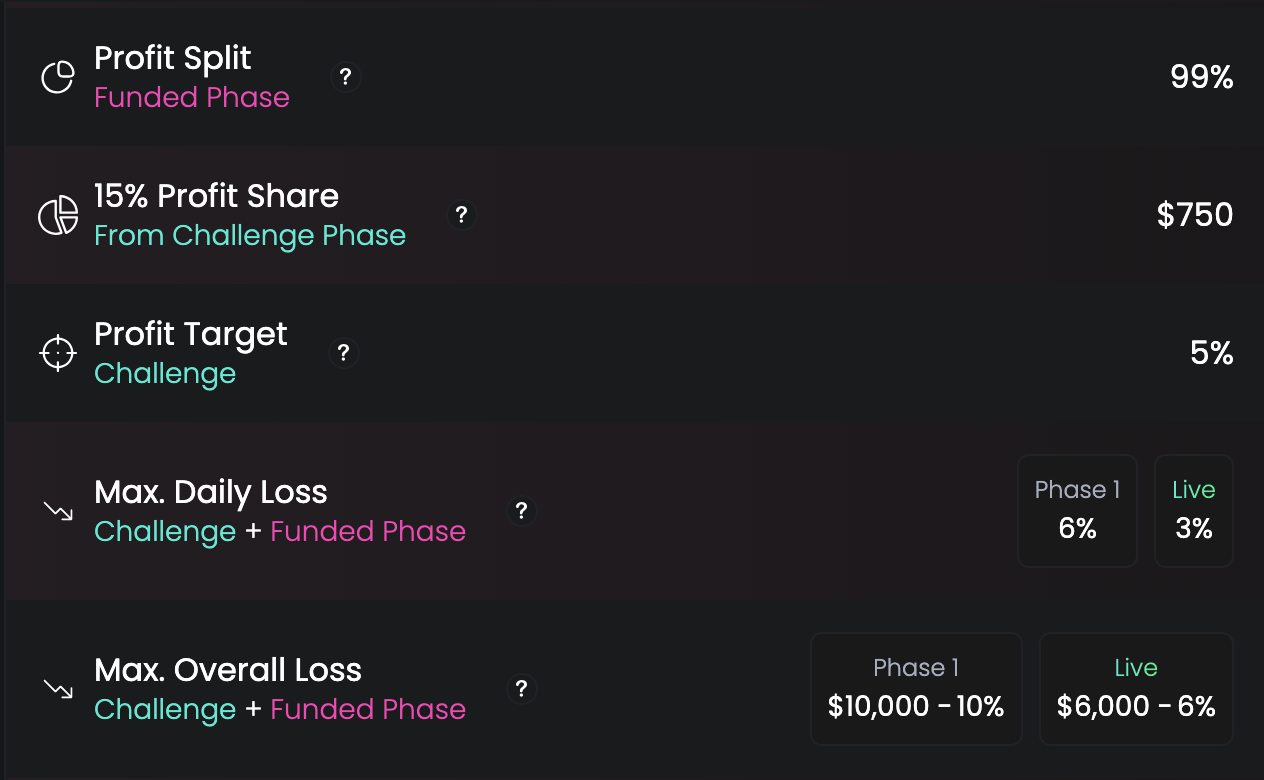
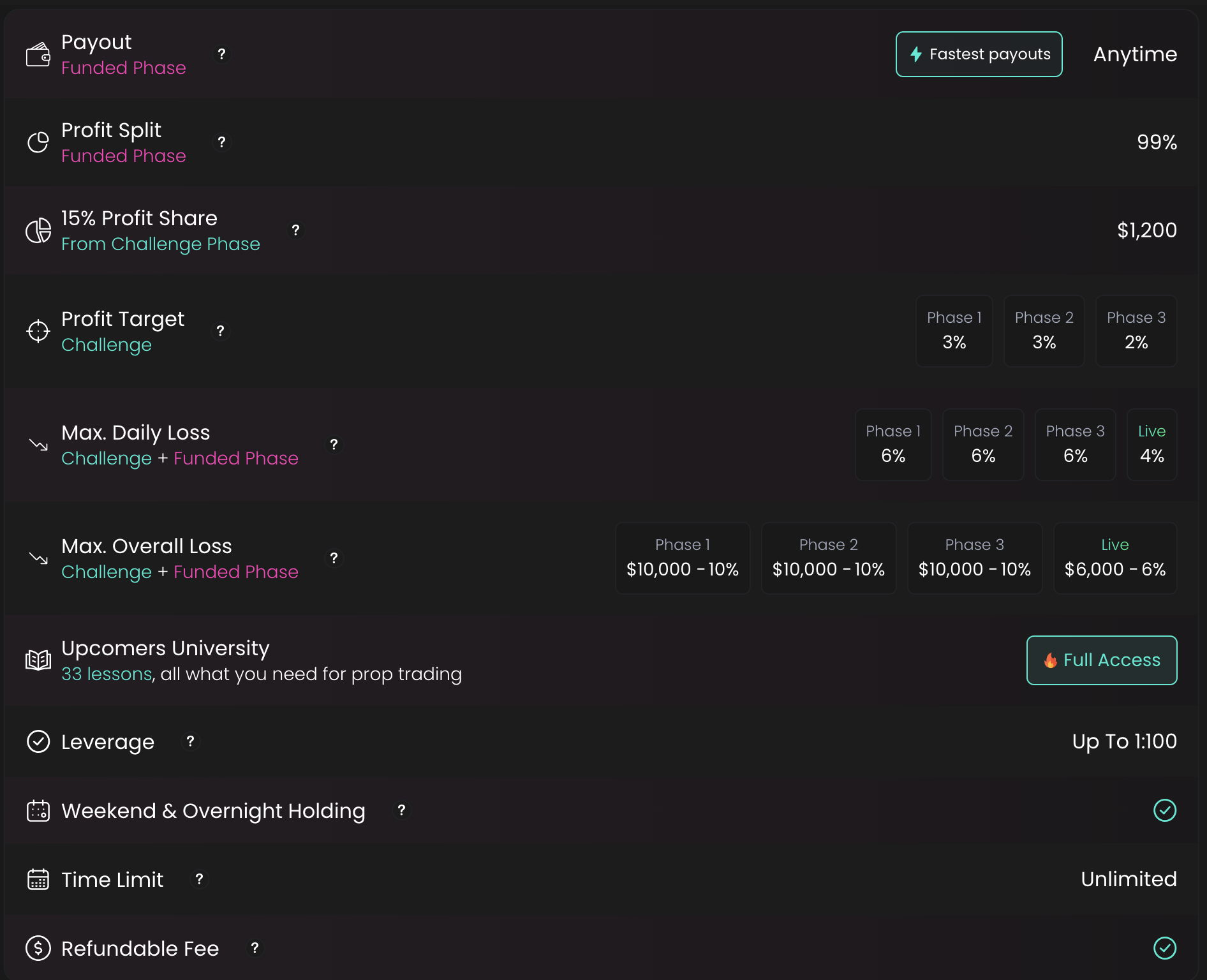
A Classic 100K account: rules and limits.
As shown above, Upcomers splits funded-phase profits 99% to you and 1% to them.
On top of that, you earn a 15% profit share on the profit you made during your challenge phase, paid once you grow your funded account by 20%. On a 100K account with a 5% profit target, your challenge profit is $5,000 — so your profit share is $750 (15% of $5,000).
Now the loss limits — the rules you most need to respect.
The Max Daily Loss is the most you can lose in a single day. On this 100K account that's 6% ($6,000) during the challenge phase and 3% ($3,000) during the funded phase. The limit moves with your balance: start the day at $102,000 and your max daily loss becomes $6,120 (challenge) or $3,060 (funded). Drop below it and your account is closed — you'd need to start over. (The funded-phase percentage varies by account type — it's 3% on this 1-step account but 4% on the 3-step account shown later, so always check your own account's figure.)
The Max Overall Loss works the same way: fall below the maximum — 10% during the challenge, 6% when funded — and the account is closed. Traders call this "blowing your account." I blew 14 of them, so I'd know.
This is why risk management is the single most important skill in prop trading — arguably the only one that reliably produces profits. The good news: it is learnable, and this guide will show you how to trade without breaching these limits.
How to choose your account
Prices and account types change from time to time; what stays consistent is the range of account sizes. The right choice depends on your trading strategy.
For me, a 100K account or larger works best, because my strategy includes trades that can run to a $500–$1,000 loss (0.5%–1% of account size). My personal rule: if I'm down about 1% of my starting balance for the day, I stop and wait for tomorrow — well clear of the daily loss limit.
Rule of thumb for beginners: pick a relatively large account, but trade small. A bigger account gives you room to learn your strategy without blowing it, and it will still serve you well once you're consistent.
The Upcomers checkout
How to buy your Upcomers account
The steps below walk through the Upcomers checkout screens so you know exactly what to choose.
Before you buy — create your free PlutsMe account first. Sign in with Google → Your members area will be waiting when you come back, and it's where you'll upload your proof once you've bought.
Referral link — I earn a commission at no extra cost to you. Code yfqv1119 is applied automatically.
Choose your market
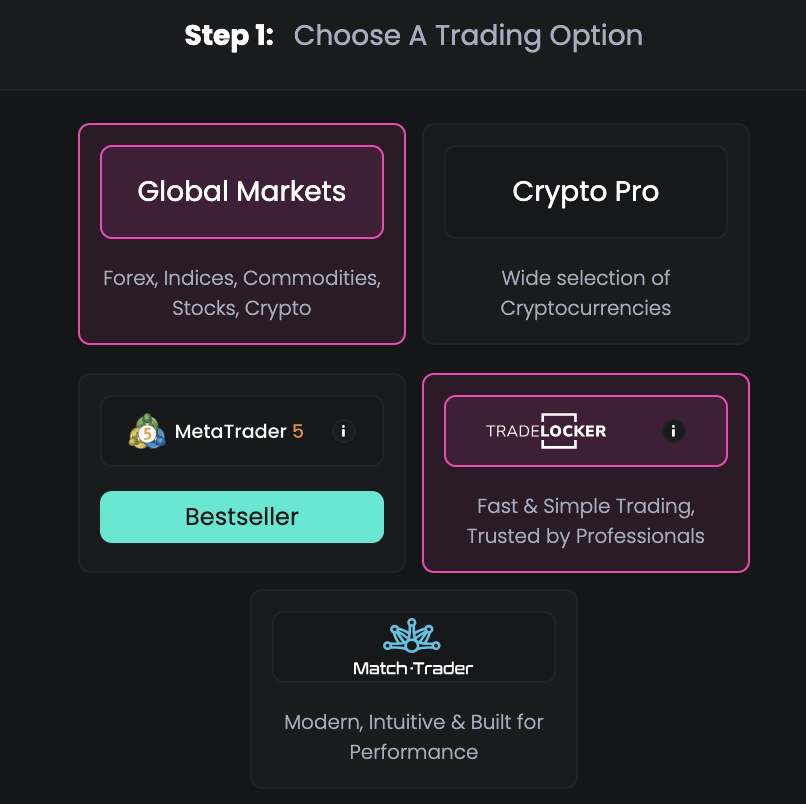
Global Markets or Crypto. I prefer Global Markets, so I can trade the relatively calm SPX500 or US100. You'll also pick your trading platform here — I like TradeLocker, but choose whatever you're most comfortable with.
Step 1 — choosing your market and platform.
Choose your evaluation type
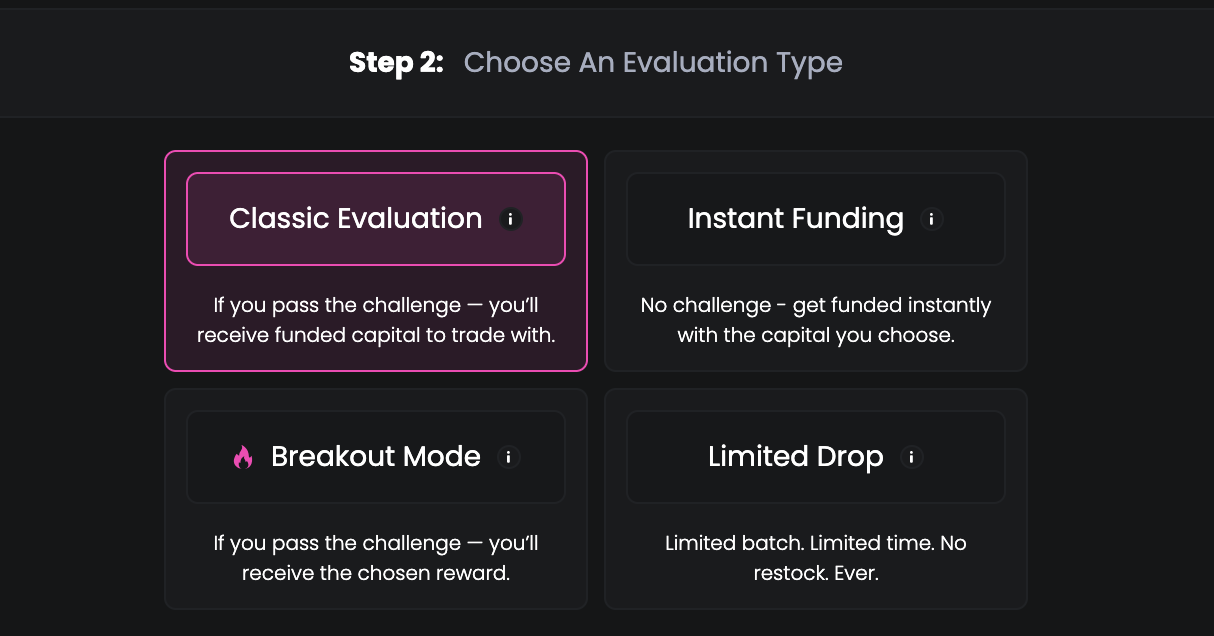
I suggest Classic Evaluation: pass the challenge and you receive funded capital to trade. Instant Funding skips the challenge but costs considerably more; Breakout Mode lets you pick your reward; Limited Drop is a limited-time, limited-batch offer that often isn't available.
Step 2 — evaluation types.
Choose your account — phases and size
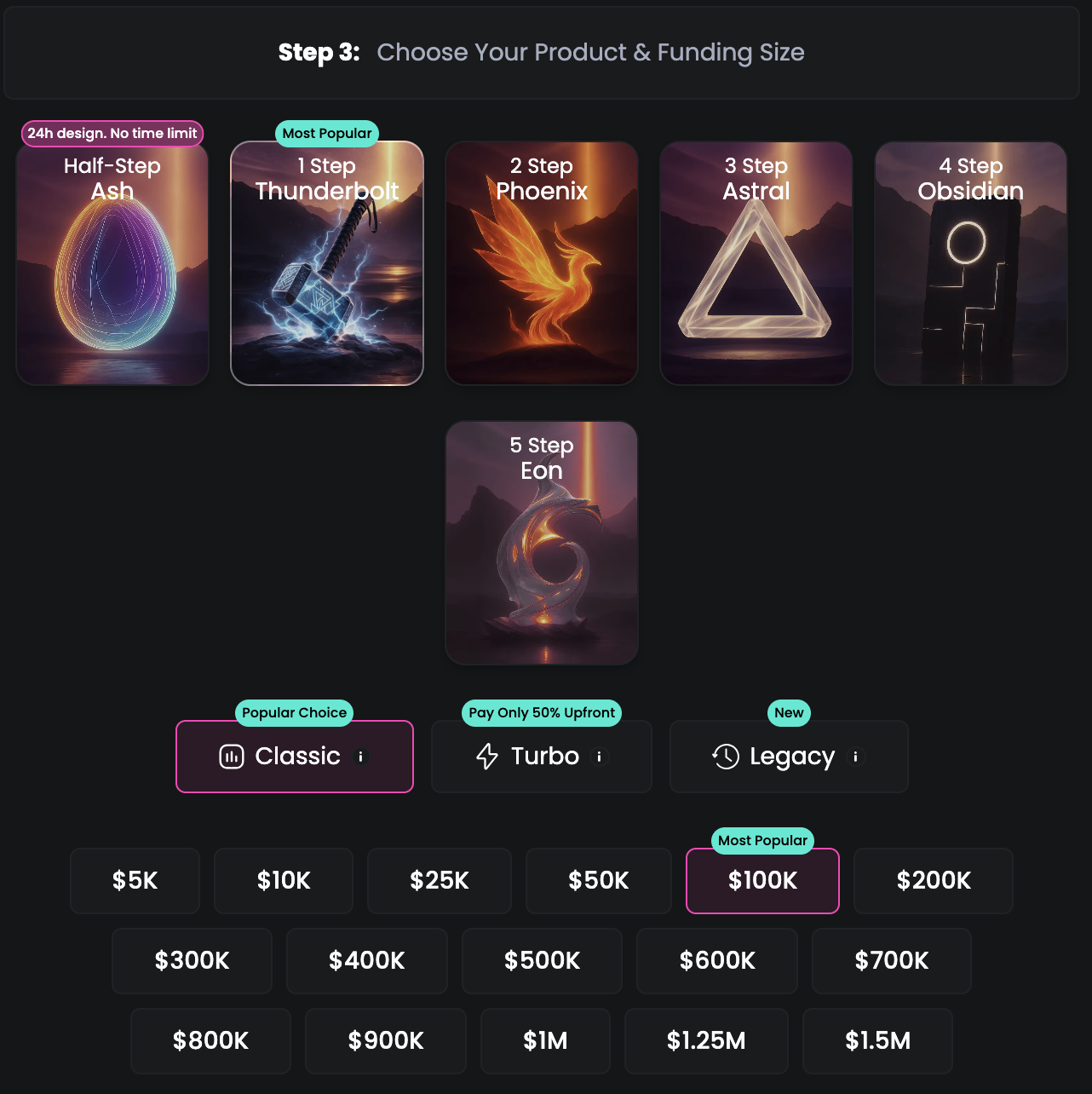
More phases means a more affordable account but usually a longer path to funded. Bigger accounts cost more but give you larger daily and overall loss limits, plus bigger payouts. I usually take the 100K or 200K 1-step account. Whether you're a beginner or not, I'd pair a larger account with the discount above — then, as a beginner, keep your individual trades small while you learn.
Step 3 — product and funding size.
Learn your account's rules before you trade
Rules differ by account type. Here's an example of a 3-step account's rules:
Example — a 3-step account's rules and limits.
Check the code
Before you pay, make sure the code yfqv1119 is applied at checkout so the extra 5% is included on top of the standard promotion.
That's it. Once your account is funded, log in to your dashboard to get your trading platform credentials — they'll look something like this:
Your login credentials
PlatformTradeLocker
AccountD#••••••••
Login••••••••@upcomers.com
Password••••••••••••
ServerUPCOMS
Example only — values masked for safety.
Treat these like a password: never share a real credentials screenshot publicly. The panel above is an example with the values masked.
Want the bot and the guidance?
You're ready to trade. For step-by-step guidance and my trade-entry bot — the same tools I use to stay inside the rules and reach payout — become a member below.
A proprietary trading firm that funds traders with its own capital and shares the profits.
Challenge / evaluation
The test phase where you prove you can trade to the firm's rules before getting a funded account.
Funded account
The live account you trade after passing the challenge, where you earn a profit share.
Profit target
The gain you must reach to pass a challenge phase — typically 3%–8% of account size.
Profit split
How funded-phase profit is divided between you and the firm. Upcomers' is 99% / 1%.
Max Daily Loss
The most you may lose in a single trading day before the account is closed. It moves with your balance.
Max Overall Loss / drawdown
The lowest your balance may fall, ever, before the account is closed.
Blowing an account
Breaching a loss limit so the account is closed. You'd have to start over with a new one.
Payout
Withdrawing your share of the profit from a funded account.
Scaling
Increasing your account size or limits over time by hitting growth milestones.
Common questions
FAQ
There's no fixed answer — it depends on your strategy, your risk per trade, and the market. Upcomers' classic evaluation has no time limit, so you can go at your own pace. Rushing to hit the profit target is one of the fastest ways to blow an account.
The account is closed and the evaluation fee you paid is not returned. You'd need to buy a new account to try again. This is the real cost of prop trading, and it's why risk management matters more than anything else.
No — you pay for the evaluation, not the trading capital. The firm provides the capital. Your financial risk is limited to the cost of the account, but treat that cost as money you could lose.
It depends where you live — rules around prop firms and the products they offer have been changing in several markets. Check Upcomers' own terms and your local regulations before you sign up. This guide can't tell you what's legal where you are.
Once you have a funded account and meet the payout conditions, you withdraw your share of the profit. With Upcomers your share of funded-phase profit is 99%, and your first payout also refunds your registration fee and adds a bonus account. Always confirm the current payout terms on Upcomers' site.
Yes — in two ways, and I'd rather be plain about both. First, I receive a commission when you sign up through the link or code yfqv1119 (at no extra cost to you, and the link gives you a better price than going direct). Second, I get a share of the 1% Upcomers keeps from funded-account profits — so I keep earning only if you trade well and reach payouts. My interest is tied to your success, not just your sign-up.
No. Everything here is educational and reflects my personal experience and preferences. Nothing on this page is financial, investment or trading advice, and nothing is a recommendation to take any specific trade or buy any specific product.
Who's behind this guide
About me
Hey, I'm Yonatan. By day, I'm a software developer. By market open, I'm a Nasdaq day trader.
My path to consistent profitability wasn't overnight. Over the last 2.5 years, I went from passive index investing to active Nasdaq day trading. I quickly realized that risking my own account balance wasn't a smart way to scale.
Then I found prop trading — and realized I could scale without risking my savings. It allowed me to trade massive capital while keeping my personal financial risk at near-zero. After a year of grinding, I now consistently clear 3 to 4 figures a day trading Nasdaq futures.
My rules for success
Keep your capital safe. Never risk your life savings when you can leverage a prop firm.
Use the best tech. A seamless back-office and reliable broker are non-negotiable.
Partner with the right firm. After trying the field, Upcomers is the only firm I trust. Their 99/1 profit split and zero-time-limit challenges are unmatched in the industry.
I taught myself everything from scratch. No secrets, no gatekeeping — just the system I use daily and Upcomers as my platform.
Free members area
Inside the members area
The members area is free — unlocked once your Upcomers purchase is verified. Here's what's waiting when you get in.
📈
The Strategy
Be consistent — the mindset behind 95% of failures
Always know the trend — MACD across 4 time frames
Don't buy the top — wait for the pullback
Wait for the confirmation candle
Set stop and target before you click buy (ATR-based)
Start long, build shorts later
📖
Lessons
Finding the trend
Don't buy the top
Setting the stop with ATR
Each lesson is a short focused read with chart diagrams.
🤖
Trade-entry bot
The bot I use to enforce my own risk rules automatically — pre-configured to keep losses inside the prop-firm limits so discipline doesn't depend on how you feel at 3pm on a red day.
Unlocks after you submit 50 trades using the guide's rules. The bot enforces what you should already know by heart — earn it first.
Become a member — get the bot, the lessons & the risk rules
This site (PlutsMe) is your free dashboard — the bot, lessons and risk guidance live here and unlock once your Upcomers purchase is verified. You need both: PlutsMe to access the tools, Upcomers to trade. Here's the full path:
1Create your free PlutsMe account.Sign in with Google → Free, 10 seconds. This is where the tools will live once you're approved.
2Buy your Upcomers account — the prop firm you'll trade with. Open the Upcomers checkout → Use code yfqv1119 for an extra 5% off. The guide above walks through exactly what to choose.
3Upload your Upcomers order confirmation in your PlutsMe dashboard. I review every one personally.
4Get approved — the bot, guidance and lessons unlock automatically. Reviews take up to 4 hours, usually much less.
Membership is free. The manual proof check is just to confirm you signed up through the guide — see the disclosure near the top for why that's tied to how this works.
Already bought Upcomers? You can skip step 2 — sign in and go straight to uploading your proof of purchase.
Not ready yet?
Save this guide for later
I'll email you the link so you can come back when you are.